New paper: Gene Co-Expression Networks Highlight Key Nodes Associated With Ammonium Nitrate in Sugarcane - Collaboration with UNICAMP
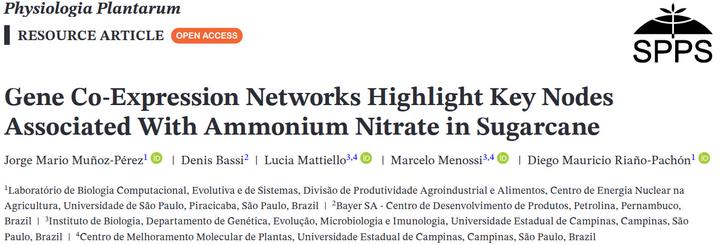
Gene Co-Expression Networks Highlight Key Nodes Associated With Ammonium Nitrate in Sugarcane
A new study from our research group at CENA/USP, led by PhD student Jorge Mario Muñoz-Pérez (now a postdoctoral researcher at ESALQ/USP), brings important advances to the understanding of how sugarcane manages nitrogen at the molecular level. Working in close collaboration with Marcelo Menossi’s team at UNICAMP, the project mapped the gene expression landscape of two contrasting sugarcane genotypes exposed to different nitrogen conditions, generating one of the most detailed gene co-expression networks available for the crop.
By analyzing 48 leaf segments with RNA-seq and building regulatory modules, Jorge uncovered how efficient and inefficient genotypes activate distinct molecular programs when nitrogen levels change. The nitrogen-efficient genotype showed tighter coordination of carbon metabolism, stress mitigation, and photosynthetic adjustments, while the inefficient one relied on broader, less targeted responses. Among the 199 co-expression modules identified, the study highlighted several MYB transcription factors and previously uncharacterized genes as central regulators of nitrogen use efficiency.
This work not only reveals new biological insights but also provides a valuable resource for future sugarcane breeding, including publicly available datasets, co-expression networks, and candidate genes. It also celebrates a successful partnership between CENA/USP and UNICAMP’s Plant Molecular Improvement Center, reinforcing how collaborative science drives innovation in Brazil’s major bioenergy crops.
All the transcriptomics datasets underlying our findings are publicly available the bioproject: PRJNA1176579, additional datasets are avalilab at FigShare.
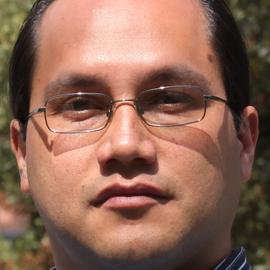
Diego Mauricio Riaño-Pachón
Assistant Professor (MS3.2) in Computational, Evolutionary and Sistems Biology
I am a computational biologist/bioinformatician at the University of São Paulo, Campus Luiz de Queiroz (Piracicaba/SP, Brazil).
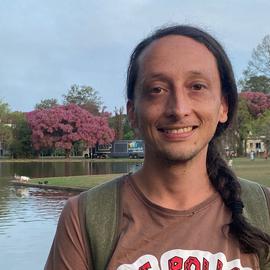
Jorge Mario Muñoz Pérez
PhD student - PPG - Ciências CENA/USP - Sugarcane Co-expression networks
I got my PhD from PPG - Ciências at the Center for Nuclear Energy in Agriculture, University of São Paulo in Feb 2025. I am interested in the intersection of Plant Biology, Programing and Mathemathics. I have worked in Plant Biotechnology, Population Genomics, Machine Learning applied to the discovery of anti-microbial peptides. Currenlty i turned into Sugarcane omics, focusing on genomic resources and gene Co-expression network analysis.